

Site Search
Search within product
第730号 2021(R03).05発行
Click here for PDF version
§果樹の盛土式根圏制御栽培における肥培管理技術
Fruit Tree Research Laboratory, Research and Development Department, Tochigi Prefectural Agricultural Experiment Station
(現 栃木県農業大学校)
高橋 優太郎
§土のはなし−第1回
よい土とはどんな土か
Jcam Agri Co.
北海道支店 技術顧問
松中 照夫
Fertilizer management technology in heaped root zone control cultivation of fruit trees.
Fruit Tree Research Laboratory, Research and Development Department, Tochigi Prefectural Agricultural Experiment Station
(現 栃木県農業大学校)
高橋 優太郎
Introduction
Fill-fill type root zone control cultivation is a method of cultivating fruit trees in a limited amount of fill, which is separated from the ground by a root barrier sheet and covered with medium. The method allows for early maturing and high-yielding fruit trees through careful management of watering according to the growth of the tree. The Tochigi Prefectural Agricultural Experiment Station developed this technique and established it for pears.
The medium is a mixture of red ball soil and bark compost at a ratio of 2:1 by volume, and the volume of medium per tree is 150 liters. A root-impermeable sheet called a "root barrier sheet" is laid down, the medium is piled on top, and the saplings are planted in a trapezoidal shape. The root zone is restricted so that the trees are compact. The planting interval is 2.0 m between trees and 2.5 to 3.0 m between rows, and the number of trees planted per 10 a is 200 at 2.5 m between rows and 185 at 2.7 m between rows. The main branches are branched at a height of 90 cm above the ground to form a two-branch, one-letter tree, and 16 resultant branches are induced at a 45° angle upward from the two-branch, one-letter skeleton to form a Y-shaped tree.
成木では,結果枝1本あたりの着果数は5果が目安で,1樹あたりでは80果を目標としている。ナシでは植え付けの翌年から収穫が可能で,植え付け4年目には樹形が完成し,「幸水」で慣行の平棚栽培の2倍となる10aあたり5〜6tの収量を実証した。早期成園化,多収化に加え,培土が地面から隔絶されていることから,白紋羽病等の土壌病害や,いや地の回避にも非常に有効である。盛土式根圏制御栽培の導入に際しては,専用のY字棚や,水源や電源の確保が必要となる。初期経費は10aあたり200万円程度が必要となるが,高い収量性を背景として,導入コストを償却しつつ,導入前を上回る収益が得られることを実証した。
Initially, the technology was developed for the pear "Kosui", but was later expanded to other varieties. Since 2008, we have organized a joint research team with public experimental and research institutes in other prefectures and private companies, and have demonstrated early high-yielding effects in seven crops: pear, grape, peach, fig, oyster, apple, and pear. However, the fertilizer management was conducted in accordance with that for pears, and no study had yet been conducted on the fertilizer management technology for each crop. Therefore, in order to clarify the optimal fertilizer application methods for grapes and peaches, we present the results of the trials conducted from 2008 to 2020.
Fertilizer management of grapes
(1) Testing Method
(1) Outline of cultivated species
The test was conducted at the Tochigi Prefectural Agricultural Experiment Station. The cultivar was "Shine Muscat" and was grown in short rows with 2.0 m between trees, 2.7 m between rows, and 150 L of soil. Watering was applied according to the growth stage using an automatic irrigation controller, and watering was increased gradually from 6 liters per tree per day at the start of watering (around March 20) to 36 liters per tree per day after fruit set. Base fertilizer was applied just before the start of watering.
The fruit set was set at 45 grains per bunch, with 10 bunches per tree in the second year of planting in 2008 because the trees were still small, and 22 bunches per tree from 2028 to 2020, when the trees were fully formed. The general cultivation management was based on the short-shoot cultivation of Cheinmuscat, and the management specific to the heaped root-zone controlled cultivation was based on the heaped root-zone controlled cultivation of pears.
(2) Fertilizer selection
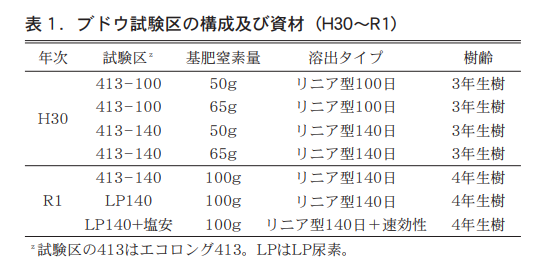
①平成30年は,基肥窒素量や窒素溶出期間の違いによるシャインマスカットの樹体生育,果実品質への影響を調査した。ナシの根圏制御栽培で慣行となっていたリニア型(溶出が直線的)被覆燐硝安加里(エコロング413)を用い,溶出日数100日タイプと140日タイプの比較を行った。なお,収穫後は礼肥としてNK化成606 (16−0−16) を全処理区に施用した(表1) 。
②令和元年は,平成30年の結果(後述)を受け,エコロング413−140タイプとリニア型LPコート140タイプの比較を行った。LPコート区では,重焼リンおよび塩化加里を混合し,窒素,リン酸,加里の成分量がエコロング区と同一となるよう調整した。また,LPコートのうち窒素成分量で2割を速効性窒素(塩安)に置き換えた区を設定した。これは,新梢の初期生育が遅れると着果可能な中庸から強勢な枝の確保が難しくなるため,生育初期の窒素溶出量を増やし,初期生育の改善を狙ったものである。なお,収穫後は礼肥としてNK化成606 (16−0−16) を全処理区に施用した(表1) 。
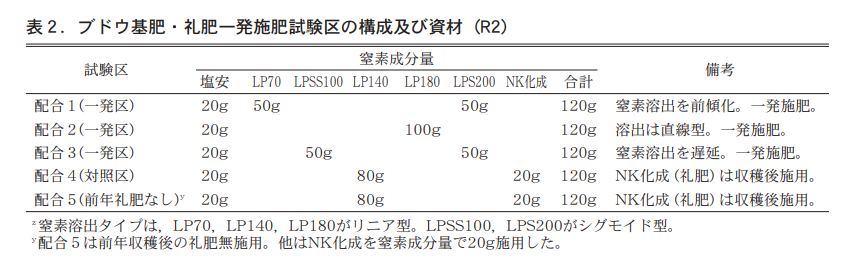
③令和2年は,基肥と礼肥の同時一発施肥が可能かどうか検討した。溶出タイプや日数の異なるLP尿素の組み合わせにより,一発施肥体系を想定した処理区を設定した(表2) 。
(2) Results and Discussion
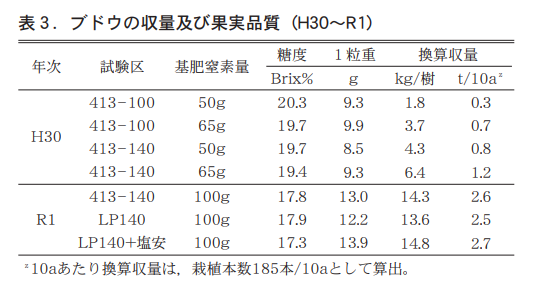
(1) In a trial conducted in 2008, yield increased with a slow-release nitrogen leaching period of 140 days compared to 100 days, and with a nitrogen application of 65 g compared to 50 g for third-year trees. In the case of the expanding canopy, longer leaching period and higher nitrogen application increased the number of moderately to vigorously growing shoots that were able to set fruit and increased yield and one-grain weight (Table 3).
(2) Compared to when all of the basal nitrogen was applied with a slow-acting LP coat, single-seed weight tended to be larger when 20% of basal nitrogen was applied with a fast-acting ammonium chloride. This suggests that increasing nitrogen fertilization in the early growth stage promotes grain enlargement (Table 3).
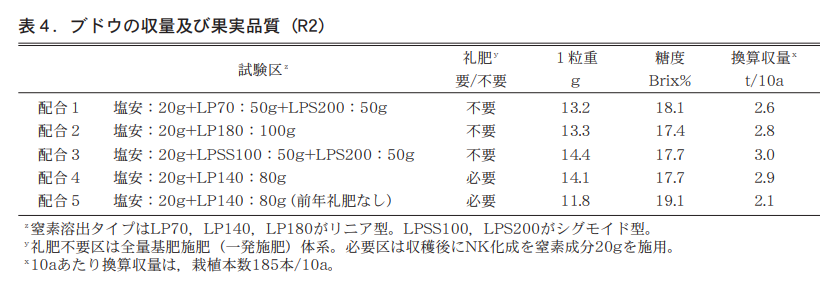
(3) In the case of 5th year old Cheyenne Muscat trees, one-grain weight increased when sigmoidal LP coat (which suppresses dissolution in the first half of the season and begins dissolution in the second half) was mixed with different types of dissolution days and 20% of the fast-acting nitrogen, ammonium chloride, was also added. type (LPSS100) with 50 g of nitrogen component, 50 g of Sigmoid LP Coat 200 type (LPS200), and 20 g of ammonium chloride. This was based on the assumption of simultaneous one-shot application of base fertilizer and retrofitting fertilizer by combining fertilizer with different nitrogen leaching periods, and showed that a labor-saving fertilizer application system was possible (Table 4).
(4) Based on the above, one-grain weight increased when 20% of the applied nitrogen was replaced with fast-acting nitrogen compared to when the entire amount of base fertilizer was applied with slow-acting nitrogen in the case of Cheyenne Muscat, we investigated simultaneous one-shot application of base fertilizer and courtesy fertilizer. The maximum one-grain weight and the maximum converted yield per 10a were obtained when two types of sigmoidal LP coat and ammonium chloride were mixed (LPSS100 (50 g) + LPS200 (50 g) + ammonium chloride (20 g); both with nitrogen content), which suppressed nitrogen leaching in the first half. Although the sigmoidal LP Coat 200 type is mixed as a substitute for fertilizer and its effect on growth in the following year needs to be confirmed, no abnormalities in growth were observed in the first year of application and the yield was excellent, indicating that a one-shot fertilization system is feasible.
Fertilizer management for peaches
(1) Testing Method
(1) Outline of cultivated species
The test was conducted at the Tochigi Prefectural Agricultural Experiment Station. The test varieties were 'Nikkawa Hakuho', 'Akatsuki', and 'Kawanakajima Hakuto'. The test grape varieties were two-branch Y-tailoring with a tree spacing of 2.0 m, row spacing of 2.7 m, and a soil volume of 150 L. The soil volume was 150 L. The test grape varieties were grown in a Y-tailoring system with two main branches. Watering was applied according to the growth stage using an automatic watering controller, starting with 10 liters per tree per day at the beginning of watering (around March 20) and gradually increasing to 35 liters per tree per day at the maximum amount of water during the fruit fertilization period. Base fertilizer was applied just before the start of watering. Fruit set was 60 per tree. General management was based on conventional peach cultivation, and specific management for heaped root-zone controlled cultivation was based on heaped root-zone controlled cultivation of pears.
(2) Fertilizer selection
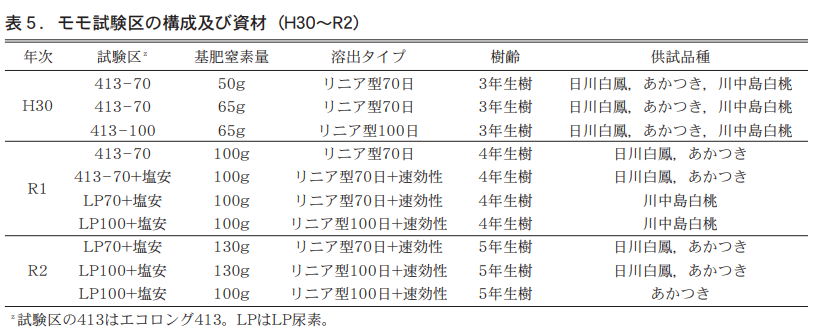
①平成30年は,基肥窒素量や窒素溶出期間の違いによるモモの樹体生育,果実品質への影響を調査した。ナシの根圏制御栽培で慣行となっていたリニア型被覆燐硝安加里(エコロング413)を用い,溶出日数70日タイプと100日タイプの比較を行った。
品種は,「日川白鳳」「あかつき」「川中島白桃」を供試した。なお,収穫後は礼肥としてNK化成606 (16−0−16) を全処理区に施用した(表5) 。
②令和元年は,エコロング413とLPコートを供試した。「日川白鳳」「あかつき」では溶出日数70日タイプのエコロングを,「川中島白桃」では溶出日数100日タイプのLPコートを供試した。また,基肥全量を緩効性窒素で施用した場合と,窒素成分で2割を速効性窒素(塩安)で代替した場合の比較を行った。これは,初期の窒素溶出を増やすことで初期生育を改善することを目的とした。なお,収穫後は礼肥としてNK化成606 (16−0−16) を全処理区に施用した。
③令和2年度は緩効性のLP尿素をベースに,速効性の塩安を窒素成分で2割混合して,樹体生育や果実品質に及ぼす影響を調査した(表5) 。
(2) Results and Discussion
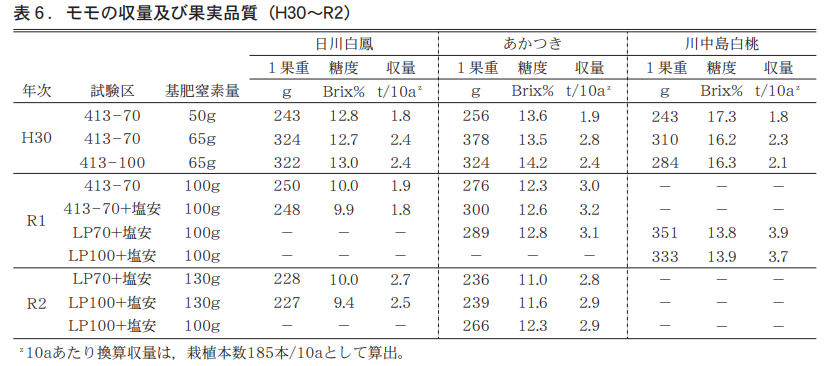
(1) In the trial conducted in 2008, higher nitrogen application resulted in larger one-fruit weight and higher yield in all three peach cultivars grown under controlled rhizosphere cultivation. In addition, a comparison of nitrogen leaching periods showed that the 70-day type produced higher yields than the 100-day type. In the case of the peach cultivar, it was considered that sufficient fertilizer effect in the early stage of growth would lead to higher yields (Table 6).
(2) In 2028, based on the results of the previous year, a treatment zone with fast-acting nitrogen was set up in order to increase nitrogen leaching in the early growth stage. The yield of "AKATSUKI" was higher when fast-acting nitrogen was added than when all nitrogen was applied as slow-acting nitrogen. This was considered to be due to the fact that the initial growth of the tree was more vigorous because nitrogen leaching was secured in the early stage of growth. However, in the late-maturing Kawanakajima Hakuto (Kawanakajima White Peach), the application of LP Coat 70 type resulted in lower vigor of new shoots compared to LP Coat 100 type. The number of moderately vigorous to vigorous shoots, which are candidates for lateral branch renewal, decreased, and it was expected that lateral branch renewal would become increasingly difficult from the following year onward. This suggests that, although improvement of early growth is necessary, excessive concentration of fertilizer application in the early stage of growth may reduce the vigor of shoots and make it difficult to secure candidates for lateral branch regeneration in late-maturing varieties (Table 6).
(3) In 2020, a comparison was made between the 100-type linear LP coat and the 70-type LP coat, both of which were mixed with 20% salts at the nitrogen component ratio, for "Hirakawa Hakuho" and "Akatsuki," and although the 70-type showed slightly stronger shoot vigor, no clear difference in fruit quality was observed between it and the 100-type (Table 6). Table 6).
(4) Based on the above, there was no clear difference between the LP Coat 70 type, which was mixed with 20% fast-acting nitrogen at the nitrogen component ratio, and the 100 type under the same conditions for early- to mid-season new varieties, but for "Kawanakajima Hakuto," a late-ripening variety, the application of the 70 type reduced shoot vigor, suggesting that the resulting branch renewal in the following year may be difficult. However, the application of Type 70 to "Kawanakajima Hakuto," a late maturing variety, may reduce the vigor of shoots and make it difficult to renew the resulting branches in the following year. Therefore, it was considered that the linear type LP Coat Type 100 was suitable as a base and 20% mixed with fast-acting nitrogen as a nitrogen component when comprehensively dealing with early- to late-maturing varieties.
4. points to keep in mind for technology dissemination
This study was conducted on young vines up to the fifth year of age (the fourth year or older is considered mature in root-zone controlled cultivation), and the effects of consecutive annual applications over a long period of time were not examined. In addition, a simultaneous one-shot application system of basal and supplementary fertilizer was considered for grapes, but it should be noted that the effects of substituting supplementary fertilizer need to be confirmed for the following year's growth, and there are points that have not been fully examined at this point in time.
§土のはなし−第1回
よい土とはどんな土か
Jcam Agri Co.
北海道支店 技術顧問
松中 照夫
Starting with this month's issue, I will be writing a series of articles titled "Soil Matters" for a while. I would like to provide soil-related information in a reading style that is somewhat different from the technical information in the other articles in this magazine. First of all, I would like to discuss what kind of soil is "good soil," which is often talked about by people in the agricultural industry.
1. experienced chefs call it "good soil" just by looking at it...
About 10 years ago in spring, I visited a farm at the foot of Mt. Yotei in Niseko, Hokkaido, with a veteran chef from a famous hotel in Sapporo. They were planting potatoes. A TV reporter asked us what we thought of the field. The veteran chef immediately replied, "The potatoes from this field must be delicious. You can tell by the dark, soft soil. The smell of the soil, which is so strong that it makes your mouth water, guarantees that you will get potatoes that will turn into a powder when you boil them. He said. I was amazed at how easily he could say, "You will get delicious potatoes" just by looking at the soil.
I was happy that the chef considered the soil important enough to determine the taste of the potatoes. However, I cannot for the life of me believe that "black, soft, good-looking soil" determines the taste and yield of potatoes. If it were determined by appearance, we wouldn't have to bother with labor-intensive cross-sectional soil surveys and soil diagnostics.
2. Is soil with a lot of compost or soil with many earthworms "good soil"?
Whenever I ask farmers what kind of soil is "good soil," a phrase is bound to come up. They say things like, "Good soil is soil that has been given plenty of compost," or "You can tell if it is good soil by the number of earthworms it has.
If a "good soil" can be produced by giving plenty of compost, then there is no need for livestock farmers to produce an excess of compost. Even livestock farmers may have farmland, and if they give as much as they can, they will have "good soil. The question is, how much is "plenty" in the phrase "give plenty of manure"? The same is true for "whether there are many earthworms or not. Even if the soil is good if there are many earthworms, how much is "plenty"? Without a clear answer, it is impossible to judge whether the soil is good or bad.
There is nothing inherently good or bad about soil.
Until around the 19th century, the understanding of soil was that it was a soft object composed of finely crushed rocks covering the surface of the earth's crust. This view was challenged by the young Russian geologist Dokuchaev (1846-1903). He traversed approximately 10,000 km of the Russian land from north to south and observed the cross-section of the soil. He noticed that each of the cold and warm regions had its own unique soil profile.
He believed that soil is formed by the interaction of various factors, such as the type of rock from which it is made, the climate, flora, fauna, and topography of the site, and that the soil changes over time. Given certain environmental conditions, the same soil will be formed if the raw materials are the same. However, even if the raw materials are the same, the soil produced will be different if the environmental conditions are different. This is because the action of living organisms, which play an important role in soil formation, differs greatly depending on the environment. Dochkachev realized that the environment creates soil.
According to Dochtayev's view, we cannot make a value judgment about the soil produced in a given environment as good or bad. This is because the soil produced in a given environment is the only soil that can be produced in that environment.
On the other hand, we who are involved in agriculture judge "good soil" or "bad soil" based on the implicit premise that crops are to be cultivated and on the criterion of whether or not crops can be cultivated without inhibiting their growth in response to that premise. If the criteria are different, the soil may be "good soil" for agriculture, but "bad soil" for the foundation of a large condominium building. Soil itself is not good or bad. It is merely a value judgment made by people.
What kind of soil, then, is soil that does not inhibit the growth of crops, that is, soil that is good for crop production?
4. 4 conditions for good soil for crop production
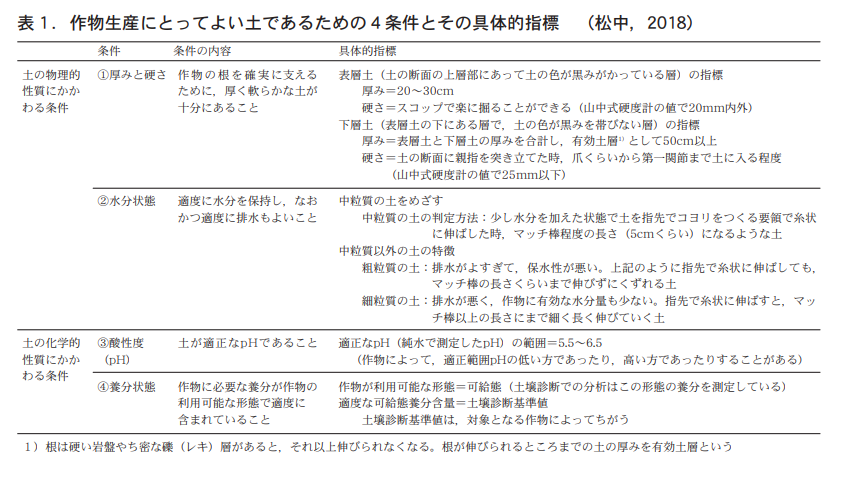
それは,次の①から④の4条件を満たすことができる土であると私は考えている。すなわち,
①作物の根を確実に支えることができるように,厚く軟らかな土が十分にあること,
②適度に水分を保ち,なおかつ適度に排水がよいこと,
③土が極端な酸性やアルカリ性を示さないこと,
④作物に必要な養分を適度に含んでいること,
である。ここで①と②は土の物理的な性質に関わる条件,③と④は土の化学的な性質に関わる条件である。
However, since the above description does not provide specific numerical information to serve as indicators, it is not possible to determine whether each of the conditions is satisfied or not. Table 1 summarizes the four conditions for good soil for crop production, including the specific indicators.
We plan to explain each of these conditions and indicators in the next and subsequent issues. We hope you will look forward to it.
5. concept of biological properties of soil
By the way, when I present the above four conditions, I am often asked why they do not include conditions on the biological properties of the soil (from microbes to animals). Why is it that these four conditions do not include the biological properties of the soil (from microorganisms to animals)? It is not easy to fully explain why in the limited space of a paper. However, we can at least point out the following
All of the above four conditions for good soil have a significant impact on the life of organisms in the soil. However, we do not believe that the fulfillment of these four conditions has a negative impact on the life of organisms in the soil. For this reason, we have not added the biological condition of the soil to the conditions for good soil.